
We welcome the opportunity to submit a response to the Welsh Affairs Committee based on our recent inspections of prisons in Wales.
His Majesty’s Inspectorate of Prisons (HMI Prisons) is an independent inspectorate whose duties are primarily set out in section 5A of the Prison Act. We provide independent scrutiny of the conditions for and treatment of prisoners and other detainees, and report on our findings. To note, HMI Prisons also inspects court custody in Wales and we would be happy to provide additional information to the Committee on this area, if useful.
HMI Prisons’ inspections are carried out against published inspection criteria known as Expectations.[1] We set our own inspection criteria to ensure transparency and independence. These contain our four healthy prison tests (safety, respect, purposeful activity, and preparation for release) plus a set of criteria for judging the effectiveness of leadership.
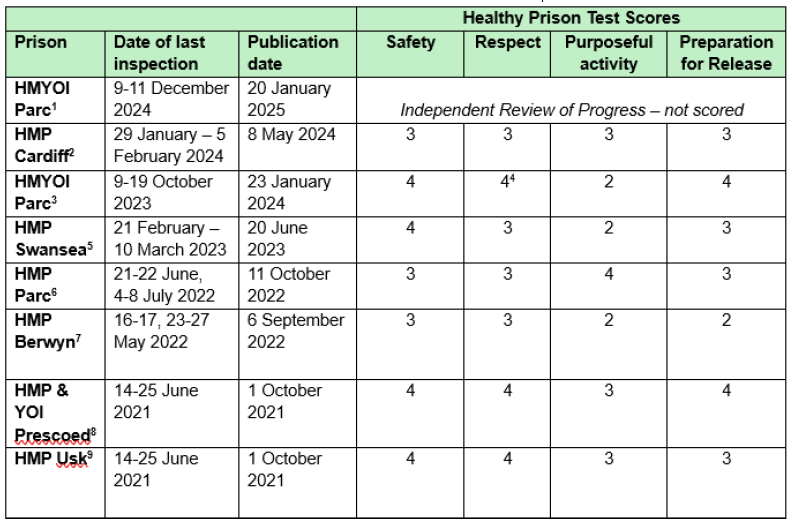
The starting point for all our inspections is outcomes for prisoners. For each healthy prison test, our inspection team will make one of the following judgements with an equivalent numerical score from 1 to 4:
a. Outcomes for prisoners are good (4);
b. Outcomes for prisoners are reasonably good (3);
c. Outcomes for prisoners are not sufficiently good (2); or
d. Outcomes for prisoners are poor (1).
Our inspections of prisons in Wales are conducted jointly with Estyn and Healthcare Inspectorate Wales. This joint work means expert knowledge is deployed in inspections and avoids multiple inspection visits.
Prisons in Wales have typically performed well in our four Healthy Prison Tests. The table below contains the scores we have given Welsh prisons and the one YOI in our most recent published inspection reports.
We have also undertaken inspections at both HMP Berwyn and HMP Parc recently, though findings have yet to be published. We would be happy to discuss the findings from these two inspections with the Committee, particularly as findings at Parc prison were concerning.
Whilst aspects of this inquiry are not directly relevant to HMI Prisons findings, we thought it might be helpful for the Committee to be aware of our judgements about the establishments in Wales to help inform proceedings. The findings below are all drawn from the published inspection reports referenced in the table above.
Table 1. Most recent published inspections of each Welsh prison
In the past, we have seen examples of strong leadership in several Welsh prisons. At HMYOI Parc, leaders and staff had developed a supportive culture that enabled children to engage in a variety of activities on offer and children felt that staff cared and took an active interest in them. Leadership was also important at HMP Usk and HMP & YOI Prescoed in the continued success of both prisons when we last inspected. Leaders had instilled a genuine sense of community through their engaged staff and consultations with prisoners. We also saw excellent partnership working at HMP Cardiff across a range of areas, including securing accommodation, support for isolated and vulnerable men, and support for those with substance use problems.
Though prisons in Wales were considered ‘reasonably good’ or ‘good’ for safety,
where we had concerns, these often mirrored those seen in English prisons, in
particular drugs and self-harm. At HMP Cardiff, 47% of prisoners told us they
believed illicit drugs were easy to access – a result confirmed by mandatory drug test results which suggested just under a quarter of all random drug tests were positive when we inspected the prison in 2023.
Both HMP Parc and HMP Berwyn experienced high levels of self-harm and at HMP Cardiff there had been ten self-inflicted deaths since our previous inspection in 2019. However, we saw evidence that staff were working to improve this at Cardiff, with a 38% decrease in the rate of self-harm. The best outcomes for prisoners existed where recommendations from the Prisons and Probation Ombudsman (PPO) were implemented, data on self-harm was regularly monitored and used to inform an understanding of the drivers of self-harm, and formal safeguarding procedures were developed and familiar to managers and staff.
Several prisons were affected by staffing shortfalls which impacted staff’s ability to build positive relationships. For example, at HMP Berwyn, prisoners expressed frustration that staff lacked the time or knowledge to help them with simple requests. However, we saw positive staff-prisoner relationships in places such as HMP Cardiff where 73% of prisoners told us they had a member of staff to turn to if they had a problem and HMP Swansea where 71% of prisoners said they felt staff were helping them to achieve their custody plan targets, a response that was significantly better than similar prisons.
Welsh prisons generally provided clean and well-maintained environments, with little or no graffiti. However, HMP Swansea and HMP Cardiff faced persistent overcrowding with many prisoners sharing cells designed for one. During our visit to HMP Cardiff, there was an infestation of mice and rats, which leaders were aware of and taking measures to address.
Time out of cell for prisoners varied between and within prisons in Wales. At HMP Parc, prisoners spent between 6 and 10.5 hours out of their cell on weekdays, however the regime was more limited at weekends. During the week at HMP Cardiff, those engaged in purposeful activity had approximately 9 hours out of cell a day, those unemployed had 3 hours out of cell, and those on the basic level of the incentives scheme only spent one hour a day out of cell. At HMP Berwyn, 52% of prisoners told us they spent less than two hours out of their cell on weekdays and 78% of prisoners told us this was true of weekends. At HMP Swansea, new arrivals were given little more than 45 minutes’ time out of cell a day on weekdays, which included half an hour in the fresh air and 15 minutes to take a shower. In contrast, prisoners at Swansea who were in full-time employment could expect over 7 hours unlocked on weekdays.
Education, skills, and work activities are inspected by Estyn. While some prisons offered strong opportunities for learning and employment, others faced challenges regarding organisation and attendance. HMP Parc, for example, had a range of opportunities from early reading and numeracy skills to vocational qualifications and higher education. Learners, including those with additional learning needs, generally made good progress, with many achieving accreditations that could aid their employment on release. Leaders at HMP Cardiff engaged with a variety of employers, tradespeople, and voluntary organisations to enhance their curriculum and resettlement support. However, while prisoners were promptly allocated to activities, some were placed in education or work they had no interest in. At HMP Swansea, leaders did not understand the causes of non-attendance at education, skills, and work and at HMP Berwyn, around a third of prisoners failed to attend education.
Some prisons recognised the geographical challenges prisoners in Wales sometimes faced when it came to contact with the outside world. At HMYOI Parc, approximately two-thirds of children were held over 50 miles from their home location. Despite this, the prison provided support to children to enable them to maintain contact with their families, including two-hour visit slots during both days of the weekend and family liaison workers which was associated with an increase in the number of visits at the prison.
Similarly, at HMP Cardiff, the lottery-funded project Invisible Walls Wales provided support to promote relationships between prisoners and their families as well as prisoners who did not receive any social visits. Prisons such as HMP Berwyn helped prisoners to maintain family ties by enabling prisoners with children of school age to attend parents’ evenings through video calls. Overall, we saw some positive interventions to support family connections across prisons in Wales.
When it came to release planning, outcomes for prisoners were mixed. Accommodation on release was an issue at multiple jails. At HMP Swansea, a third of prisoners were released homeless or in transient accommodation on the night of release in the 12 months prior to our inspection. At HMP Parc, of those being released in the next three months who told us they needed support to find accommodation, only 35% were receiving it. At HMP Cardiff and HMP Swansea, some of the basics were absent regarding through-the-gate support, such as prisoners being able to charge their mobile phones when released.
However, we also saw some encouraging initiatives to support prisoners in their return to the community. At HMP Swansea, a well-resourced resettlement team saw every prisoner on arrival, regardless of sentence, to assess their needs and deal with immediate concerns such as outstanding finances or tenancy agreements. At HMP Berwyn, staff had repurposed interview booths for resettlement teams and Offender Management Unit staff to meet prisoners plus they had devised a board game where prisoners could find information on housing support and services, as well as how to access them.
Offender management services varied in effectiveness. Prisoners at HMP Swansea credited the positive rehabilitative culture of the prison, with 86% of prisoners who had a custody plan saying they knew what they needed to do to achieve their targets and 71% saying staff were helping them to achieve those targets, compared to 45% at similar prisons. However, at HMP Berwyn, prison offender manager contact with prisoners was too inconsistent to drive sentence progression and too few offending behaviour programmes existed to meet prisoner need. At HMP Usk, probation offender manager staffing levels were insufficient to meet the high caseloads.
At our last full inspection, we reported that HMYOI Parc was the best young offender institution in England and Wales. The institution saw boys treated with care from the moment they arrived, with access to initiatives and incentives plus an active regime that encouraged positive behaviour and helped reduce violence. Many of the strengths of HMYOI Parc were owed to strong leadership and dedicated, caring staff who were prepared to work with children as individuals. This was something that continued beyond the gate, where we saw the YOI’s Needs, Engagement, Wellbeing Team engaging in home-visits with children after release and re-establishing links with community agencies.
We saw evidence of prisons meeting their commitments to Welsh speaking prisoners and Welsh heritage. For example, at HMP Parc, displays around the prison and in classrooms signalled a sense of pride in Wales and the Welsh language. Information in the reception area was available in both Welsh and English and a Welsh language coordinator had been appointed to hold focus groups, celebrate cultural events, and identify Welsh speaking staff on behalf of prisoners. The prison had also developed a community of support for Welsh speakers, including that offered by Welsh champions in classrooms, workplaces, and leisure facilities. We also observed Welsh being used during an ACCT review and a few prisoners had gained accreditations in the Welsh language.
Other notable examples of promoting the Welsh language included HMP Swansea’s Welsh social speaking club run by a Welsh peer mentor and a Welsh-speaking group which organised celebrations for St David’s Day and opportunities for those wishing to learn, improve or practice their spoken Welsh.
The absence of a women’s prison in Wales means that Welsh women serve their sentence in England. For these women, the closest prisons are HMP Styal in Wilmslow, HMP Drake Hall in Stafford, HMP Eastwood Park in Gloucestershire, and Foston Hall in Derby.
At HMP Styal[2], the Visiting Mum Project, ran by the Prison Advice and Care Trust (PACT) provided essential support to Welsh women by facilitating family contact as well as transport for children and relatives. Efforts were also underway to support approximately 30 Welsh prisoners with links to the Wales Justice Board to help with housing needs. Similarly, at HMP Eastwood Park[3], the Visiting Mums scheme offered much-needed support to women from Wales, yet ongoing funding had not been secured at the time of inspection.
In terms of returning to the community, about 1,000 women had been released from HMP Styal in the last year to areas across the north-west and Wales.
[2] HM Inspectorate of Prisons – HMP/YOI Styal
[3] HM Inspectorate of Prisons – HMP/YOI Eastwood Park
I hope that you find this information useful. Should you require anything further, please do not hesitate to contact me.
March 2025