
HMYOI Feltham A
Report on an independent review of progress at HMYOI Feltham by HM Chief Inspector of Prisons, 26–28 May 2026
Section 1: Chief Inspector’s summary (Back to top)
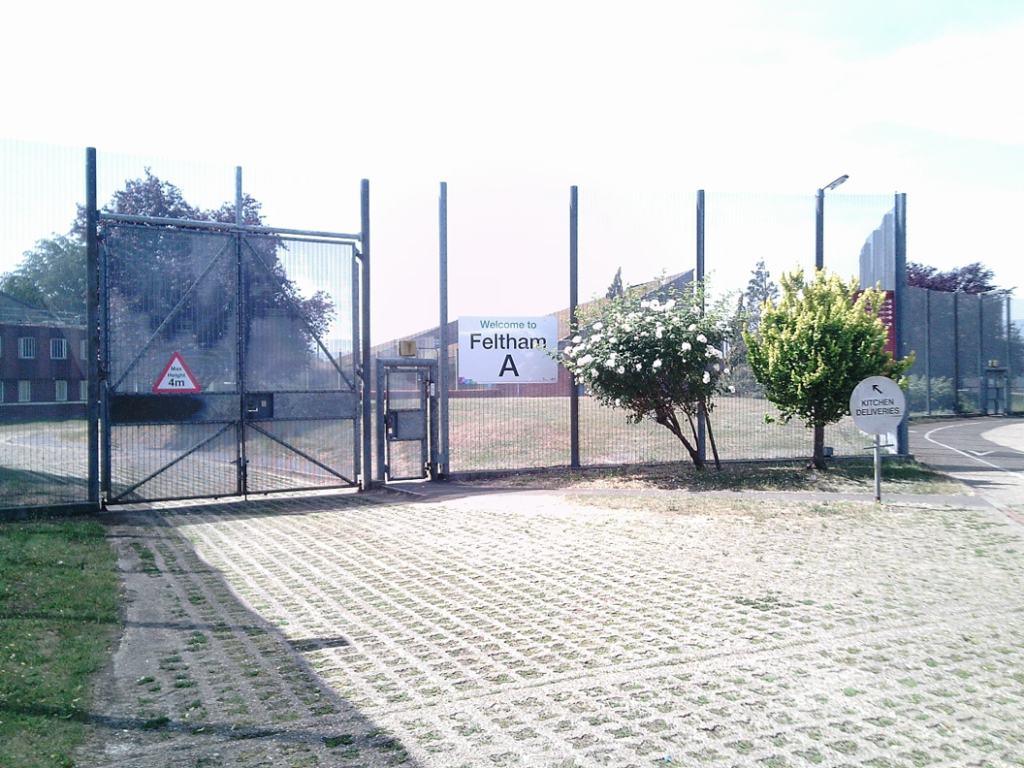
Feltham A is a young offender institution (YOI) in West London that can hold up to 126 boys aged 15 to 18. However, at the time of this independent review of progress (IRP), the population was just 74. In the month before this IRP, a child tragically died in custody at Feltham, and several investigations into this were ongoing during our visit.
This review followed up on the concerns we raised at our last inspection of HMYOI Feltham in 2025.
What we found at our last inspection
At our previous inspections of HMYOI Feltham in 2024 and 2025 we made the following judgements about outcomes for children.
Figure 1: HMYOI Feltham healthy establishment outcomes in 2024 and 2025
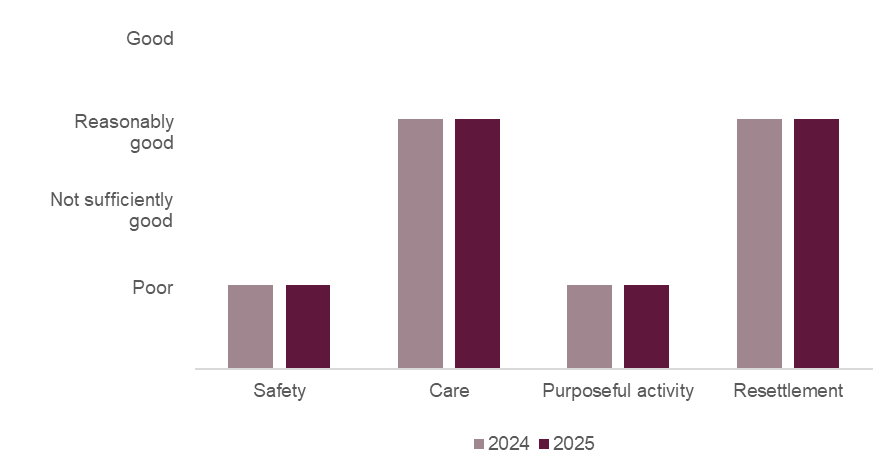
At both inspections we found serious failures in our test of ‘safety’ and ‘purposeful activity’, where outcomes for children were poor. Outcomes in ‘care’ and ‘resettlement’ were ‘reasonably good’.
What we found during this review visit
At this independent review of progress, we reviewed 10 concerns and found that improvement had been too slow, particularly in those areas of most importance to children. We assessed progress to be insufficient or worse in seven areas, while it was reasonable in just three.
The substantive governor returned to the institution in December 2025 after an absence of 11 months working with the Youth Custody Service central team. By this time, Feltham had begun to experience acute staffing shortfalls, with large numbers of frontline staff unavailable for work due to sickness or other reasons. For several months, children had experienced very little access to education and spent much of every day locked in their cells.
By early 2026, the situation had become so concerning that national leaders reduced the population, provided staff from other establishments and approved overtime payments. This had led to some very recent improvements, but even with this support, the average time out of cell in the month before the inspection was little more than five hours a day.
We remain concerned that, despite the efforts of local managers, the number of frontline staff who were unable to be deployed remained far too high. These now persistent difficulties were the reason for the limited progress for many of the concerns we reviewed, including access to important elements of the regime, or services children should have been able to get to.
Outcomes for children at Feltham were no longer experiencing the deterioration they had been reduced to between November and February, but performance had simply returned to the level we saw at the time of the inspection. Much more should be possible with the resources available and what was now a very small population.
Charlie Taylor, HM Chief Inspector of Prisons, June 2026
Section 2: Key findings (Back to top)
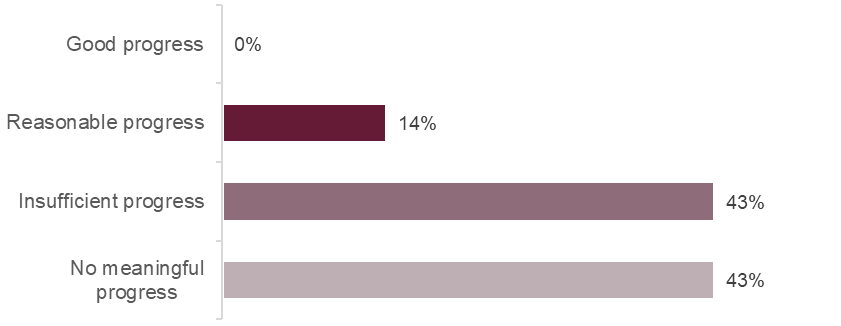
At this IRP visit, we followed up seven concerns from our most recent inspection in June 2025, and Ofsted followed up three themes based on their latest inspection.
HMI Prisons judged that there was reasonable progress in one concern, insufficient progress in three concerns and no meaningful progress in three concerns.
Figure 2: Progress on HMI Prisons concerns from June 2025 inspection (n=7)
This bar chart excludes any concerns that were followed up as part of a theme within Ofsted’s concurrent prison monitoring visit.
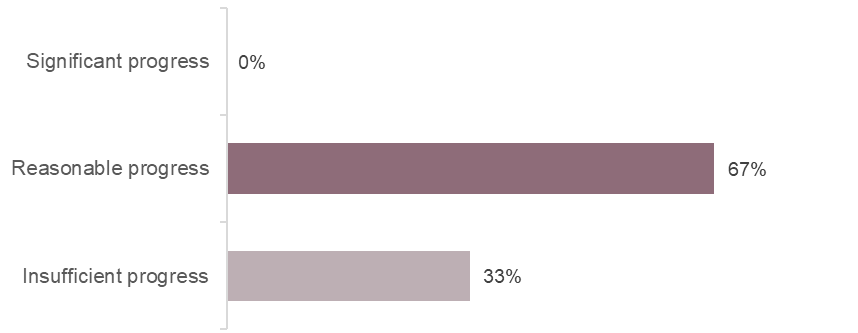
Ofsted judged that there was reasonable progress in two themes and insufficient progress in one theme.
Figure 3: Progress on Ofsted themes from June 2025 inspection (n=3)
Notable positive practice
We define notable positive practice as:
Evidence of our expectations being met to deliver particularly good outcomes for prisoners, and/or particularly original or creative approaches to problem-solving.
Inspectors found two examples of notable positive practice during this IRP visit, which other prisons may be able to learn from or replicate. Unless otherwise specified, these examples are not formally evaluated, are a snapshot in time and may not be suitable for other establishments. They show some of the ways our expectations might be met, but are by no means the only way.
| 1. | Any restraint not recorded on body-worn video camera or CCTV is subject to an automatic safeguard referral. If there is an allegation within the referral it is sent to the local authority designated officer (LADO) for further scrutiny (see Use of force). |
| 2. | Psychologists quality assured custody support plans (see Relationships between staff and children). |
Section 3: Progress against our concerns and Ofsted themes (Back to top)
The following provides a brief description of our findings in relation to each concern followed up from the full inspection in 2025.
Leadership
Concern: The rate of sickness among frontline staff was among the highest of all prisons. This made it difficult for leaders to build effective relationships or deliver a reliable daily routine.
Staff sickness rates had improved slightly since the last inspection but remained among the highest of all prisons. During this IRP, the institution was able to deploy less than two-thirds of frontline youth justice workers. Short-term sickness and staff vacancies continued to undermine the delivery of a full and purposeful regime.
National leaders had diverted children to other sites, provided detached duty staff and approved overtime. A revised core day had been introduced two months before the IRP. This had led to marginal improvement in time out of cell, but it still depended on staff deciding to attend.
Weekly oversight meetings were held and line managers received training in absence and performance management, which was positive. Monthly staff forums and weekly walkaround sessions by the People Hub (the team responsible for HR and staff support) had provided leaders with insights into areas of concern and suggestions for improvement.
While oversight and management of absence had improved, the persistently low numbers of staff available for work continued to prevent leaders from delivering a reliable daily routine.
We considered that the YOI had made no meaningful progress in this area.
Behaviour management
Concern: Behaviour management by staff was ineffective. Inconsistency, combined with a lack of meaningful rewards or sanctions, meant that children were not motivated to improve their behaviour.
Leaders had been slow to take action regarding this concern. Consultation on the incentives policy began in January 2026 with several forums with staff and children. Following this, a new incentive and earned privileges scheme with a broader range of incentives had been introduced, but implemented just before the inspection.
Children told us that they appreciated some of these changes, such as dining out and having access to toasters and air fryers, but not all were available yet across most of the wings. Children told us that too few items were currently available to buy in the shop to enable them to make full use of the new facilities.
Children also told us that the difference in spending money available at the higher levels of the scheme, as well as access to the youth club, and increased gym time in the evenings, were big incentives to behave.
Oversight of the incentives scheme had improved since the inspection. Local records indicated that reviews were now conducted more promptly, meaning that children generally received rewards or sanctions without undue delay. Leaders had been monitoring the scheme more closely since January, and as a result it was being applied more consistently.
Despite these improvements, children’s poor perception of the behaviour management systems remained unchanged from the time of the inspection. In our survey, the proportion of children who felt the rewards or incentives for good behaviour encouraged them to behave well remained the same. Children told us that this was partly because they did not have enough time out of their cells or access to activities and leaders had not managed to increase these incentives for individuals who engaged and behaved well.
We considered that the YOI had made insufficient progress in this area.
Use of force
Concern: The rate of use of force was too high and there was no plan to reduce it. Staff did not routinely draw or activate their body-worn cameras, which prevented leaders from scrutinising incidents properly and applying learning where required.
The amount of force used against children had reduced since our last inspection but remained the highest of all YOIs. In the six months before this IRP, the rate of use of force was 96 per 100 children per month, compared to 116 at the last inspection.
Oversight had been strengthened. The Restraint and Behaviour Management Meeting had been split to provide strengthened scrutiny of use of force which linked to the violence reduction meeting. Both led to useful action to improve practice and reduce the levels of use of force at Feltham.
All incidents of force were now viewed by the MMPR (see glossary) team. Any incidents of concern were referred to the weekly scrutiny meeting, which was chaired by the deputy governor, and any learning from this meeting was shared with staff. The LADO attended a meeting each quarter where a selection of footage was viewed to provide an additional layer of independent scrutiny.
Leaders had focused on the use of body-worn video cameras. At the time of this visit, around 95% of all incidents where force was used had been recorded. The safeguarding lead had implemented a policy whereby any incident of restraint where body-worn video or CCTV footage was not available was referred to the local authority for scrutiny. We felt this extra level of safeguarding was good practice.
At our last inspection, over 300 use of force statements were overdue. This had been reduced considerably and was now around 50. All children who had been restrained were now offered a debrief with staff within 72 hours, which was much better than we saw last time.
Enhanced support teams were in place for some of the more refractory children, who were offered the opportunity to attend scrutiny meetings to view and discuss the restraints they were involved in. Children told us that this helped them understand why staff acted as they did and made it less likely that they would need to be restrained in future.
We considered that the YOI had made reasonable progress in this area.
Relationships between staff and children
Concern: Custody support plan meetings between staff and children were frequently not taking place.
Since the inspection, leaders had prioritised improving relationships between staff and children through the introduction of monthly check-ins by CuSP officers, supported by weekly welfare checks. In our survey, 82% of children said they felt they could turn to staff for help if they had a problem, suggesting that their confidence in staff support had improved.
Each child was allocated a nominated officer within their residential unit. However, there was a risk that this approach could lead to inconsistency, particularly when children moved units or when allocated officers did not establish good relationships with the children, limiting the effectiveness of the support.
Electronic records showed variability in the quality of CuSP sessions. Leaders had set clear expectations for these sessions, including the requirement to agree a goal with the child. All records were subject to quality assurance by a psychologist, although this had not yet secured consistent practice.
Most children knew their nominated officer. However, some did not recognise the value of CuSP sessions and chose to disengage in favour of other activities. Leaders had introduced changes to the core day, including a dedicated weekly timeslot for CuSP, to improve participation. More recently, some children reported that sessions were more meaningful and better tailored to their individual needs.
Staff absences and gaps in training resulted in an over-reliance on a small number of staff to deliver CuSP sessions. In the month before the IRP, one staff member completed 30 sessions.
We considered that the YOI had made insufficient progress in this area.
Health services
Concern: There were regular delays in escorting children for their
medicines and other appointments. As a result, some health appointments were curtailed or missed.
The number of missed or cancelled appointments had reduced since the previous inspection but remained high. In the six months before this visit, 680 appointments had been cancelled or missed, compared with 1,204 in the same period before the last inspection, representing a 43% reduction. Despite this improvement, non-attendance continued to limit children’s access to services.
Progress elsewhere was more limited, for example, since the inspection, 33% of planned offending behaviour interventions had not been delivered, reducing children’s access to planned support.
Health care leaders provided daily updates at the governor’s morning meetings, which meant that potential concerns could be addressed immediately. There was a clear escalation process for health care staff if children did not attend appointments.
Mobile medication trolleys reduced the need for children to be escorted to medical hatches but introduced a new risk of children diverting and accessing medication that was not prescribed to them. There were plans to mitigate this by repurposing a cell in each of the wings where medication could be issued and triaging children who requested access to medical services.
The opening of a dedicated health centre had been delayed, which meant that children still had to be escorted to appointments in HMP Feltham.
Leaders continued to use Patient and Public Voice (NHS) to gather children’s opinions about the medical care provided. Leaders had recently commissioned a project to better understand how to communicate with children, especially when notifying them of appointments.
We considered that the YOI had made insufficient progress in this area.
Time out of cell
Concern: Children spent too much time locked in their cells.
Since our last inspection children spent an average of around four hours out of their cell a day which was not an improvement on the period before the inspection.
The average masked substantial variation between children and from month to month. Time out of cell was worse in the months from November 2025 to February 2026. In response leaders had very recently introduced a new core day and in the month before our visit the average was five hours.
National leaders had provided an on-site adviser to support the development of an enrichment programme. Mountain biking, the Duke of Edinburgh’s Award scheme, fitness challenges and access to youth clubs had been delivered successfully. However, as with other regime elements the programme remained dependent on otherwise unpredictable and inconsistent staff availability.
We considered that the YOI had made no meaningful progress in this area.
Reintegration planning
Concern: Housing was identified too close to children’s release date, impeding planning for education, training and employment in the community.
Leaders had a good understanding of the causes of this concern, which centred on the timeframe’s community partners worked to, as well as the common practice of not looking for education or work placements before accommodation was secured.
Leaders had recently started escalating issues more consistently with community partners when children did not have accommodation or an education or work placement as they neared release. However, since the inspection there had been many cases where these had not been in place and this had not triggered any escalation.
This activity had not yet had an effect on outcomes. Of the 50 planned releases since the inspection, only 25 had accommodation secured 10 days before release. As a result, only nine of these children left Feltham with something productive to fill their time.
We considered that the YOI had made no meaningful progress in this area.
Education, skills and work

This part of the report is written by Ofsted inspectors. Ofsted’s thematic approach reflects the monitoring visit methodology used for further education and skills providers. The themes set out the main areas for improvement in the prison’s previous inspection report or progress monitoring visit letter.
Theme 1: What progress had leaders and managers made to ensure that children received their full entitlement to education?
Following a period of considerable challenge at the YOI that impacted on the regime, leaders had taken appropriate strategic steps to increase the number of education hours children received. This included working to reduce the number of children who were kept apart from one another, increasing managerial capacity for regime planning and closer oversight of regime planning from senior leaders.
Although leaders’ actions had led to an increase in the average number of education hours that children received, this was still some way below the number of hours children were entitled to. Children mostly received far fewer than the 18.5 hours that leaders planned for them.
Children typically received a similar number of education hours to the amount they had received at the time of the last inspection. There had been a very recent increase to above this level, but it was too soon to judge whether this improvement was sustainable.
In many cases, children missed time in education due to arriving late to their lessons, which was an issue inspectors reported at the last inspection.
Ofsted considered that the YOI had made insufficient progress against this theme.
Theme 2: What progress had leaders and managers made to ensure that they provided sufficient vocational training to children?
Since the last inspection, leaders had broadened the array of vocational training courses they offered. They had widened the catering offer considerably and introduced a sports pathway, which included opportunities to gain accredited qualifications up to level 2. Leaders had also broadened the distance learning offer, which featured a suitable range of vocational opportunities at levels 2 and 3. A small proportion of children accessed distance learning courses.
There were sufficient activity spaces for all children to undertake a vocational training pathway, alongside studying English and mathematics. Almost all children at the YOI undertook a vocational training course, including those at the YOI only for a short time. In most cases, children valued their studies and the new skills they learned.
Children who studied painting and decorating and catering could develop their skills through internal work experience opportunities. This included preparing food for local homeless people and painting the education block’s sensory room in suitably neutral colours. Children with SEND and on specialised pathways to support their integration into education also accessed these opportunities.
Leaders had developed links with employers in key vocational training areas. This had to led to some employers, including those with lived experienced of prison, visiting the prison and speaking to children about working in industries such as painting and decorating, and catering. A few young people had gained employment or work experience opportunities on release as a result of these links.
Due to funding issues, leaders had not been successful in developing a planned multi-skills construction hub. As a result, the number of construction-focused vocational training activities remained small, limiting children’s opportunities to develop skills for working in this industry.
Ofsted considered that the YOI had made reasonable progress against this theme.
Theme 3: What progress had leaders and managers made in training teaching staff in phonics, so they helped children develop their reading skills, and in helping children to improve their reading skills by reading for pleasure?
Leaders had provided suitable phonics training for teachers. English teachers, vocational tutors and learning support assistants had completed training at level 3. Alongside this, leaders had introduced a specialist reading learning support assistant to help children develop their reading fluency.
Children with the lowest levels of reading ability received helpful specialist support via reading interventions. This included support for those who were not able to attend main education courses. Children developed their ability to break down sounds and decode words well.
In most vocational subject areas, teachers and trainers were at the early stages of using phonics to develop children’s reading skills. Leaders and teachers rightly recognised that there was more to do to develop the use of phonics across the curriculum.
Leaders had developed well a culture in which all children were encouraged to read for pleasure. Initiatives included well-received competitions and guest speaker events, and a focus on reading during lesson time. The approach was an inclusive one. Staff supported appropriately both reluctant readers and those who read avidly.
The library was used well to promote reading. Knowledgeable staff recommended books to meet specific children’s interests, including for those children who remained on their units and did not study alongside other children. As a result, more children were borrowing books to read for pleasure than in the previous year.
Ofsted considered that the YOI had made reasonable progress against this theme.
Section 4: Summary of judgements (Back to top)
A list of the HMI Prisons concerns and Ofsted themes followed up at this visit and the judgements made.
HMI Prisons concerns
The rate of sickness among frontline staff was among the highest of all prisons. This made it difficult for leaders to build effective relationships or deliver a reliable daily routine.
No meaningful progress
Behaviour management by staff was ineffective. Inconsistency, combined with a lack of meaningful rewards or sanctions, meant that children were not motivated to improve their behaviour.
Insufficient progress
The rate of use of force was too high and there was no plan to reduce it. Staff did not routinely draw or activate their body-worn cameras, which prevented leaders from scrutinising incidents properly and applying learning where required.
Reasonable progress
Custody support plan meetings between staff and children were frequently not taking place.
Insufficient progress
There were regular delays in escorting children for their medicines and other
appointments. As a result, some health appointments were curtailed or missed.
Insufficient progress
Children spent too much time locked in their cells.
No meaningful progress
Housing was identified too close to children’s release date, impeding planning for education, training and employment in the community.
No meaningful progress
Ofsted themes
Children did not receive their full entitlement to education which significantly
limited their chances of finding work and making a positive contribution to the
community on release.
Insufficient progress
Managers had not provided sufficient vocational training to support children’s
career ambitions or to help them to find employment on release.
Reasonable progress
Teaching staff did not receive sufficient training in phonics to help children with
their reading. Children did not have enough access to the library in order to
borrow books and develop their reading skills. Not enough children improved
their reading skills by reading for pleasure.
Reasonable progress
More about this report (Back to top)
This report contains a summary from the Chief Inspector and a brief record of our findings in relation to each concern we have followed up. You may find it helpful to refer to the report of the full inspection for further detail on the original findings (available in Our reports).
Independent reviews of progress (IRPs) are designed to improve accountability to ministers about the progress prisons make in addressing HM Inspectorate of Prisons’ concerns in between inspections. IRPs take place at the discretion of the Chief Inspector when a full inspection suggests the prison would benefit from additional scrutiny and focus on a limited number of the concerns raised at the inspection. IRPs do not therefore result in assessments against our healthy prison tests.
The aims of IRPs are to:
- assess progress against selected priority and key concerns
- support improvement
- identify any emerging difficulties or lack of progress at an early stage
- assess the sufficiency of the leadership and management response to our concerns at the full inspection.
Find out more about priority and key concerns
Inspection team
This independent review of progress was carried out by:
Angus Jones, Team leader
John Wharton, Inspector
David Foot, Inspector
Emma King, Researcher
Sophie Riley, Researcher
Jasjeet Sohal, Researcher
Sana Zahid, Researcher
Saul Pope, Ofsted inspector
Paul Breheny, Ofsted inspector
Further resources (Back to top)
Find out more about the terms and abbreviations used in this report in our glossary.