
Safety, well-being and hope: why family contact is so important to prisoners
In March we published a thematic review on the untapped potential of family contact in prisons. Sam Rasor, one of the researchers on the project, spent several weeks speaking to prisoners, finding out about the people who were most important to them and why keeping in touch mattered so much.
The interviews we conducted for this review revealed a huge amount. As soon as we started talking to prisoners, it became clear that they relied on a wide range of people. As expected, family members were central – spouses and partners were especially important as they helped arrange visits and phone calls with prisoners’ children and kept them updated on family life. Other relatives, including parents and siblings, were also important, as were wider family, including grandparents, aunts, uncles, cousins, nieces and nephews.
Many prisoners also relied on friends or former colleagues, both in the community and in other prisons, and for those without close family or friends, relationships with professionals were particularly helpful. Prisoners who had spent time in care told us that social workers and personal advisors were also important.
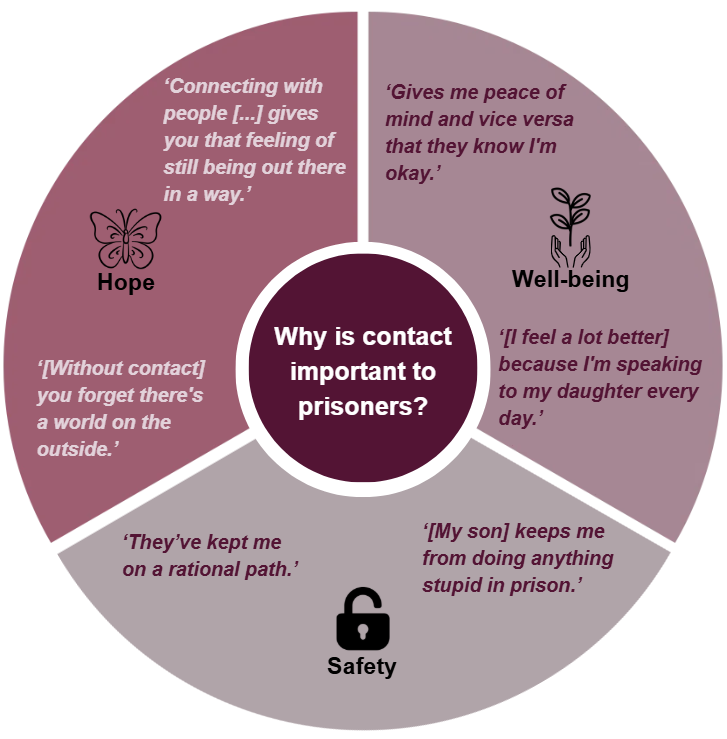
Hope
Contact with family and friends gave many prisoners a feeling of hope and the ability to picture a life beyond custody. Those who had regular contact could feel that they were still part of their family and community; they were able to maintain important bonds and keep up to date with people’s lives and events. This was especially important when prisoners had children under 18 and wanted to continue to play a parenting role.
‘When you break that bond, that’s when the problems start. Cracks start appearing in your relationship, and then when you get released, from past experiences, not that many relationships last in prison, because of that barrier.’
Regular contact helped to reassure prisoners that people outside cared for them, providing a sense of normality that was often lacking in prison. Many told us that it helped them to forget where they were.
‘In a prison setting it’s highly important [to maintain connections] because when you’re in jail for so much time you kind of start to lose connection to reality I’d call it, like you really lose the concept of time in a way, like you’ll think it’s been a month but it’s been two weeks, or its been longer like I’ve seen up and down from different people like the way they perceive time in here […]. I’d say it’s highly important you speak to people otherwise you really can lose your head in here.’
Prisoners who were held in a jail close to home were often able to feel more connected to the outside world as, unlike those located further away, they were more able to receive regular visits.
Well-being
Staying in touch with family and friends supported prisoners’ well-being and mental health, reassuring them and keeping them going during their time in jail. Many told us they felt better after speaking to someone they cared about. Family contact also helped prisoners to navigate elements of daily life in custody and provided something to look forward to each day.
‘It helps with my mental health, especially to know that I can contact my family and friends, that they’re there to support me, that we do have that strong connection and bond, just about catching up and a bit of reassurance.’
‘I was on a one-way ticket you know? I’ve got a big sentence, 41 years, you know? I was like kamikaze, I’m out. I tried every way and I was trying, trying, then I started speaking to my daughter and the officers noticed, […] they said there’s a change in you, you feel a lot better, you look a lot better, you sound a lot better.’
Regular contact offered reassurance for both prisoners and their families, which contributed to overall well-being. Prisoners told us that they knew their families struggled too, and that keeping in touch helped to improve everyone’s moods.
‘As a parent myself, you worry about your kids. Even, like my mum obviously I’m in prison, she’ll still worry. I’m still her son at the end of the day. I am 41 [but] she’ll still worry about her kids.’
Safety
Contact was also important for more practical support, for example for financial aid. Many prisoners relied on their families to send in extra money as they could not afford to buy everything they needed – including phone credit – on their prison allowance or wages alone. This helped to stop them from getting into debt, avoiding potential threats to their safety.
Many prisoners told us that keeping in touch helped them to regulate their behaviour and maintain the ‘right’ frame of mind to stay safe and out of trouble. They said it could act as motivator to behave and keep their ‘head straight’. Some said they would not care about behaving without this contact as they would have ‘nothing to lose’.
‘I would’ve fallen off the handle by now if I couldn’t have [had contact], […] I just want to get angry about everything but when I ring, when you get hold of people like my mum and that, she knows what it’ll result in if I do flip off the handle and I don’t need to be going down that road. […] it definitely is positive on the way that I behave, 100%.’
‘I think I’d have gone wayward […] having visits and someone from the outside, especially family, for me is sort of integral […] for me to have that outside voice, I suppose a voice of reason [is important]. I think without that I’d have probably made a lot more wrong decisions while I’ve been in prison. Might have got up to more mischief or just not done the right thing.’
Prisoners also recognised that preserving links to their family and wider support networks could be vital for them on release. Maintaining these ties meant they would have support when they returned to the community. This contact also helped many to progress with their sentence, acting as an essential element of rehabilitation and helping them to get ready to leave prison.
It is clear that contact with family and friends can have a significant impact on prisoners’ time in jail and their outcomes when they are released. I hope we start to see prisons addressing the findings from this thematic review, and that more prisoners are able to have regular, meaningful contact which helps to keep them safe, well and hopeful for the future.