
PE in YOIs: playing a vital role
In March we published ‘Hardly working out: barriers to physical education in prisons’[1]. This paper highlighted the situation in adult prisons, but children in young offender institutions (YOIs) often experience similar difficulties with access. HMI Prisons researcher, Alicia Grassom, explains why.
Physical education plays a vital role in the well-being, behaviour and rehabilitation of children. Children frequently tell us that that going to the gym or playing sport is one of the most positive things about their establishment and that they want more of this activity.
NHS guidance suggests that children and young people aged five to 18 should aim for at least 60 minutes of moderate-to-vigorous physical activity every day, spread throughout the week, with activities that strengthen muscles and bones. In YOIs, HMI Prisons expects children to have timetabled PE and optional recreational sessions, including at least an hour a day doing outdoor physical activities. Staff should promote the benefits of health and fitness and integrate it into training plans[2].
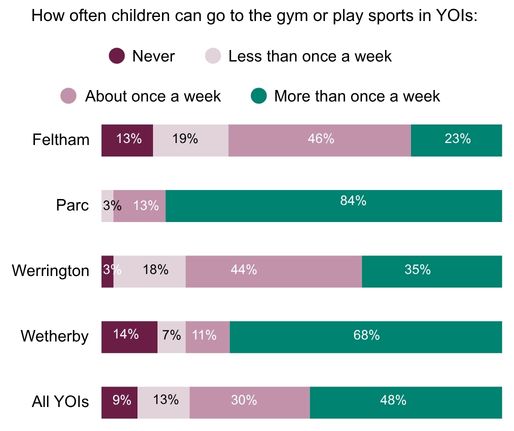
However, between April 2025 and March 2026, we found that long periods locked in cells and impoverished daily routines were limiting children’s access to PE. Over a fifth (22%) said they could not attend the gym or play sports at all during the week, or that they could attend less than once a week. Gang issues and violence had led YOIs to create complicated ‘keep apart’ lists to separate large numbers of children; this made it very difficult to operate a daily routine that included access to exercise and sport. As with other forms of purposeful activity, such as education or vocational training, staffing shortages and security incidents caused frequent cancellations, interruptions and delays to gym and sports activities.
A child’s ability to stay fit and healthy depended on where they were held. At Parc, 84% of children went to the gym or played sports more than once in a week, which was significantly higher than at all other YOIs (43%).
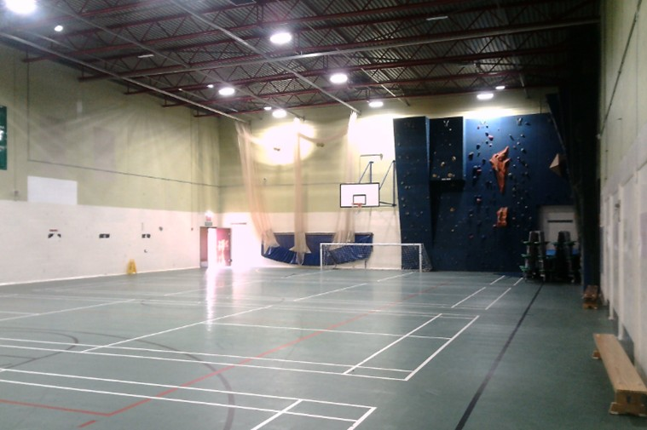
Parc managed to provide good access despite having the most limited sport facilities of the YOI sites; at multiple sites, we saw excellent facilities designed for a range of activities. At Feltham, Werrington and Wetherby these included gyms with cardiovascular and weights sections, a sports hall, an outside pitch and rock-climbing walls. Wetherby also had smaller gyms on several wings to improve accessibility beyond timetabled gym sessions.
Some YOIs ran sports sessions and some of the children at Wetherby told us that playing football, basketball and rugby was the most positive thing in the YOI for them, while children on the Keppel unit (a specialist unit for the most vulnerable children) could also take part in Parkrun every other week. However, many children told us limited space, lost balls or broken equipment meant sessions were sometimes slow, cut short or cancelled.
Ultimately children’s access to PE and sport was too dependent on staffing numbers and the reliability of the daily routine. This meant that too often excellent facilities were empty or underused. Wetherby had a well-staffed PE department – including two dedicated full-time physical education instructors (PEIs) on the Keppel unit – and all children at the YOI were inducted to the gym within 48 hours of arrival, building their confidence and ability to integrate. During interviews at Parc children told us that they could go to the gym every day if they wished, which they valued. However, Werrington and Feltham had both experienced staffing challenges and PEI shortages, which made delivery difficult.
Children responded well when additional recreational sessions were used as a reward for good behaviour, and boys at Werrington told us that additional hours out of cell were the biggest incentive for them to behave. Children on enhanced status at Werrington also had additional access to a weekly running club. However, across the YOIs ‘keep apart’ lists created many small groups of children who could only associate with a limited number of their peers, and this restricted how often lots of them could use the gym. Some children had lost all access to the gym as a punishment for poor behaviour.
Some children at Werrington, Wetherby and Parc could also complete vocational training through PE departments. Here children earned qualifications such as first aid and assisting in sport. Particularly impressive was the eight-week Sports Performance course at Wetherby, which had capacity for approximately 10% of the population, and the opportunity to achieve several qualifications. The Duke of Edinburgh award was offered at Parc and Wetherby, and Wetherby used release on temporary licence (ROTL) to complete the expedition element, including one trip to Eryri/Snowdonia.
As well as forming a vital element of children’s development, PE is also a means of countering long periods spent in cells. Across all YOIs the average time out of cell ranged from just over seven hours at Parc to 3.5 hours at Werrington, with some children receiving less than 30 minutes unlocked a day. At Werrington, to increase the amount of time children spent out of cell, cancelled classes were sometimes replaced with PE sessions, and a weekly PE session was offered to children who were separated for safety concerns. Despite the benefits of PE to well-being and behaviour, as well as its contribution to rehabilitation, not enough children are able to regularly access it. The December 2025 All-Party Parliamentary Group on Sport and Physical Activity in the Criminal Justice System (APPG) inquiry into physical activity and sport across the custodial estate in England and Wales[3] highlighted the importance of physical activity for children and called for HM Prison and Probation Service, NHS England and the Youth Custody Service to make sure that everyone in the children and young people secure estate has access to a high-quality, developmentally appropriate physical education offer. YOIs have facilities that would be the envy of most community leisure centres. The challenge is to make the best use of them to help children lead healthy, crime-free lives on release.
[1] HM Inspectorate of Prisons (2026). ‘Hardly working out: barriers to physical education in prisons. A key findings paper by HM Chief Inspector of Prisons’. Available at: Hardly working out: barriers to physical education in prisons – HM Inspectorate of Prisons
[2] HM Inspectorate of Prisons (2018). ‘Expectations. Criteria for assessing the treatment of children and conditions in prisons’. Available at: Expectations – HM Inspectorate of Prisons
[3] The All-Party Parliamentary Group (APPG) on Sport and Physical Activity in the Criminal Justice System (2025). ‘APPG Inquiry: Physical Activity and Sport across the Children and Young People Secure Estate, and Adult Custodial Estate in England and Wales’. Available at: APPG Report on Sport and Physical Activity – Alliance of Sport